
Tooth Extraction: What to Expect Before, During and After

For most people, the anticipation of a tooth extraction is worse than the procedure itself. Knowing what’s actually going to happen — and what recovery looks like day by day — makes a significant difference to how patients experience it.
Here’s what leads to an extraction, what happens on the day, and how to get through recovery without complications.
When Is a Tooth Extraction Needed?
Extraction is a last resort. The aim is always to save the tooth where possible. But there are situations where removal is the right call:
Severe decay
When decay has progressed beyond what a filling or crown can restore, extraction removes the infection and protects surrounding teeth and bone from further damage.
Irreparable fracture
A tooth cracked below the gumline or split through the root can’t be reliably restored. Extraction is usually the only viable path.
Advanced gum disease
Significant bone loss from periodontitis can leave a tooth without adequate support. Where the damage is too extensive to treat, extraction and replacement becomes the better long-term outcome.
Failed root canal
Sometimes a tooth that has had a root canal develops an infection that doesn’t respond to further treatment. If this happens, removing the tooth may be the best option.
Orthodontic crowding
Some patients need one or more teeth removed to create the space required for orthodontic treatment to work effectively.
Wisdom teeth
Impacted, partially erupted, or infection-prone wisdom teeth are one of the most common extraction scenarios. They’re removed when they can’t be cleaned properly, cause pain, or damage adjacent teeth.
Simple vs Surgical Extraction
The approach depends on the tooth’s position and condition.
Simple extraction
Indicated for fully erupted teeth that are clinically accessible above the gingival margin. Local anaesthetic is applied, the tooth is loosened with an elevator, and it is removed with forceps. Most routine extractions fall into this category and are completed quickly once the area is numb.
Surgical extraction
Required for impacted teeth, teeth broken off at the gumline, or those with curved or fused roots that make simple removal impractical. Sometimes the dentist needs to make a small cut in the gum to reach the tooth.
A small incision is made in the gum, and the tooth may be sectioned to facilitate removal. Wisdom teeth frequently require this approach.
Your Thornton dentist will assess the tooth beforehand and explain which type of extraction is needed.
What Happens on the Day
The procedure starts with local anaesthetic. Most patients are surprised at how completely it works — pressure and movement are felt, but pain is not. If at any point you experience sharp discomfort, let the dentist know immediately so that more anaesthetic can be administered.
For a simple extraction, your dentist gently loosens the tooth by rocking it back and forth until it comes free. This takes minutes rather than the drawn-out ordeal many patients expect.
For a surgical extraction, the additional steps — incision and possible division of the tooth into sections — extend the procedure time, but the anaesthetic remains effective throughout.
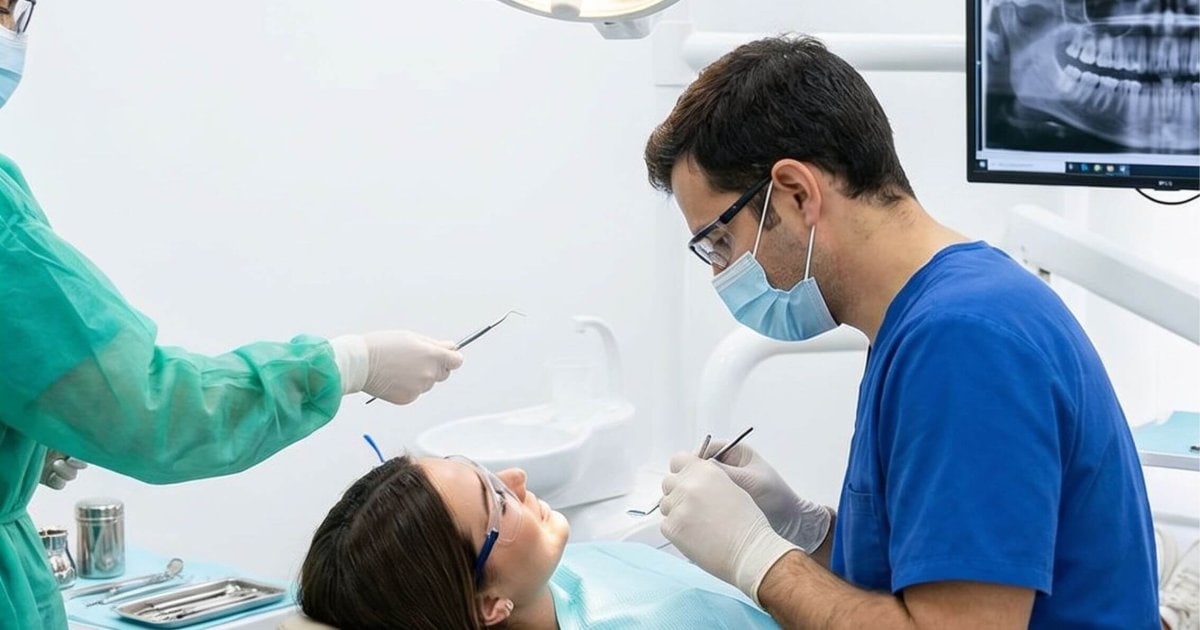
Once the tooth is out, gauze is placed over the socket. You’ll bite down firmly to control bleeding, and the team will go through aftercare instructions before you leave. If anxiety is a concern going in, mention it beforehand — there are options to make the experience more manageable.
Recovery: The First 48 Hours
The first two days set the foundation for healing. A stable blood clot forms within the extraction socket and is essential for normal healing. Premature clot dislodgement increases the risk of alveolar osteitis (dry socket).
Gauze and bleeding
After your extraction, bite down firmly on the gauze for about 30 to 45 minutes to help the area stop bleeding. Some oozing for the first few hours is normal. If bleeding continues, replace with fresh gauze and maintain pressure. If it doesn’t settle, contact the practice.
What to avoid
- Straws — suction dislodges the clot
- Smoking — significantly increases dry socket risk and impairs healing
- Forceful rinsing or spitting in the first 24 hours
- Hot food and beverages until the anaesthesia comes off entirely
- Exercising vigorously within the first 24 to 48 hours
Pain and swelling
Some discomfort and facial swelling is expected. Ibuprofen or paracetamol taken as directed manages most post-extraction pain effectively. Using an ice pack on your cheek for 20 minutes at a time during the first day can help keep swelling to a minimum.
What to eat
Stick to soft, cool foods in the first 24 hours — yoghurt, smoothies without a straw, cold soup, ice cream. Avoid anything hot, hard, or that requires chewing near the extraction site.
Recovery: Days 3–7 and Beyond
By day three, most patients feel noticeably better. Swelling peaks around 48 hours and then reduces. Pain should trend downward — if it increases after day 2, a dry socket needs to be ruled out.
Dry socket
Dry socket may develop when the blood clot is dislodged before the socket can heal, exposing the bones and nerves. The pain is deep, aching, and often radiates toward the ear — distinct from normal post-extraction soreness.
It typically develops two to four days after the procedure and is more common in smokers and lower wisdom tooth extractions. It doesn’t resolve on its own, so contact the practice promptly if you suspect it.
Saltwater rinses
From 24 hours after the extraction, gentle saltwater rinses after meals keep the socket clean. Half a teaspoon of salt in warm water — rinse softly, don’t swish hard.
What to eat
Scrambled eggs, soft pasta, mashed vegetables, soup, and yoghurt are all manageable from day two or three. Avoid hard, crunchy, or small granular foods — such as seeds, rice, and nuts — that can lodge in the socket. Chew on the opposite side where possible.
Full bone healing takes several weeks, but day-to-day function returns well before that. If you’re considering a replacement tooth — implant, bridge, or denture — your dentist will advise on timing once healing is underway.
Frequently Asked Questions
Will the extraction hurt?
Not during the procedure. Local anaesthetic blocks pain effectively — you’ll feel pressure and movement, but not pain. Post-procedure soreness is expected and manageable with standard pain relief. Most patients find the experience significantly less uncomfortable than they anticipated.
How long does a tooth extraction take?
A simple extraction typically takes 20 to 40 minutes, including anaesthetic time. A surgical extraction — particularly an impacted wisdom tooth — takes longer depending on position and complexity. Your Thornton dentist will give you a realistic estimate after assessing the tooth.
What is dry socket and how do I avoid it?
When the blood clot in the socket is lost before the socket is fully healed, a dry socket forms, which exposes the bone. To reduce the risk: no straws, no smoking, no forceful rinsing for the first 24 hours, and avoid strenuous activity for 48 hours. Smokers face significantly higher risk and should stop for at least 48 hours before and after the procedure.
When can I eat normally again?
Soft foods from day two or three. Most patients return to a near-normal diet by day five to seven, avoiding hard or small granular foods near the socket until it has closed over.
What’s normal healing and what’s not?
Normal: some bleeding in the first few hours, swelling peaking at 48 hours, mild to moderate soreness that improves daily. Not normal: heavy bleeding that doesn’t settle with pressure, pain that worsens after day two, fever, bad taste or smell from the socket, or visible bone in the extraction site. Contact the practice if any of these occur.
Tooth Extractions in Thornton
If you’ve been told a tooth needs to come out, or you’re dealing with pain that hasn’t been assessed, don’t put it off.
At Thornton Dental, we welcome patients from Thornton, Maitland, East Maitland, Metford, Beresfield, and the surrounding areas.
Call us on (02) 4966 2996 or book online.
Visit us at Thornton Shopping Centre, Shop 30/1, Taylor Ave, Thornton.